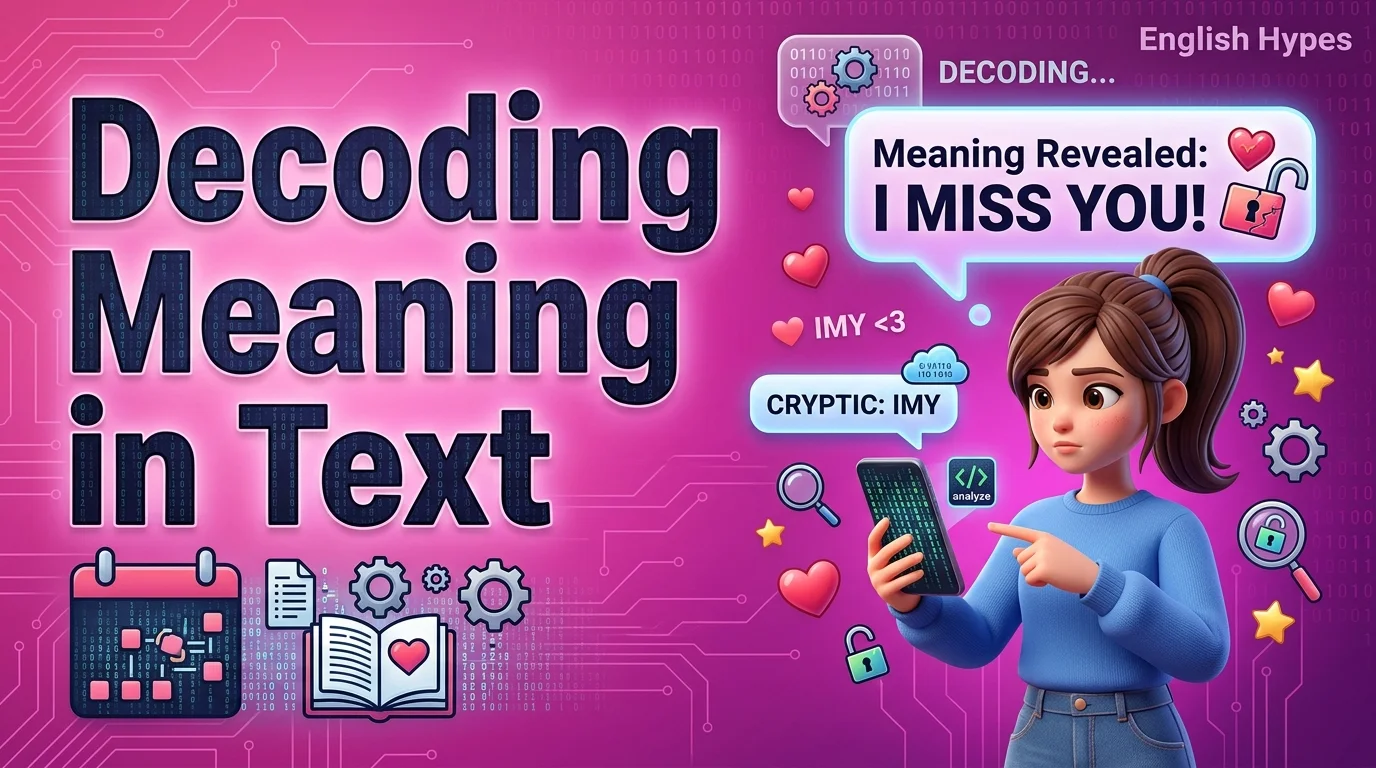
In today’s digital world, people communicate through short messages, abbreviations, emojis, and phrases that can sometimes be difficult to understand. This is why many users search for “Decoding Meaning in Text” when they come across unfamiliar wording or hidden meanings in online conversations. Understanding the “Decoding Meaning in Text” can help you interpret what someone is actually trying to say instead of relying only on the literal words.
The phrase can refer to the process of interpreting a message, abbreviation, symbol, or expression according to its context. A word may have one meaning in a casual chat and another meaning in a professional, medical, scientific, or technical setting.
Learning about “Decoding Meaning in Text” is especially useful for people who regularly use WhatsApp, Instagram, TikTok, dating apps, emails, and online communities. This guide explains what the phrase means, where it is used, how context changes interpretation, and how to respond when a message is unclear.
Meaning & Definition of Decoding Meaning in Text
“Decoding Meaning in Text” refers to the process of understanding, interpreting, or translating information contained in written communication. In simple words, decoding means figuring out what a person, sentence, abbreviation, symbol, or message is trying to communicate.
When someone searches for decoding meaning in text, they may not necessarily be asking about one particular abbreviation. They may want to understand how a written message should be interpreted.
For example, consider the message:
“Sure, whatever.”
The literal words seem simple, but the intended meaning can depend on the situation. It could express agreement, annoyance, disappointment, or sarcasm. The surrounding conversation and punctuation can help reveal the intended message.
Decoding meaning in text therefore involves more than simply looking up individual words. It can include understanding:
- The words being used
- The surrounding sentences
- Punctuation
- Emojis
- Abbreviations
- Tone
- Conversation history
- The relationship between the people communicating
In digital communication, messages are often short. Because there is no facial expression or voice tone, readers sometimes need to interpret the meaning from limited information.
Another important part of decoding meaning in text is context. The same term may have completely different meanings in different fields. For instance, a technical abbreviation may mean something specific in medicine while having an informal meaning in social media.
Therefore, the basic definition is simple: decoding meaning in text means working out what written communication actually means based on its words, context, and intended use.
Background of Decoding Meaning in Text
The idea behind decoding meaning in text is not new. People have always needed to interpret written communication. Before smartphones and social media, readers interpreted letters, books, newspapers, signs, instructions, and formal documents.
What has changed is the speed and style of modern communication. Online conversations often contain shortened words, acronyms, emojis, GIFs, memes, slang, and informal expressions. These changes have made interpretation more complicated for many readers.
Text messaging has played a major role in this development. People often shorten phrases because typing a shorter message is faster. Expressions such as “BRB,” “LOL,” or “IDK” became common examples of internet and messaging language.
Social media introduced another layer of complexity. A phrase may become popular because of a trend, meme, video, or online community. Its meaning may not be obvious to someone who is unfamiliar with that community.
This is where Decoding Meaning in Text becomes useful. Instead of assuming that a phrase has only one fixed meaning, readers can consider how it is being used.
For example, an emoji can communicate an emotion without using words. Similarly, capitalization can change how a message feels. “okay,” “Okay,” and “OKAY!” may technically contain the same basic word but can communicate different emotional impressions.
Modern communication has also created specialized language in professional and technical environments. Businesses use industry-specific terminology, while medical, scientific, aviation, and academic fields have their own abbreviations and expressions.
As a result, Decoding Meaning in Text has become an everyday communication skill. It helps people understand messages accurately across casual, social, professional, and technical environments.
Usage of Decoding Meaning in Text in Different Contexts
The process of decoding meaning in text changes depending on where the message appears. A phrase used by friends may have a completely different interpretation in a workplace or technical document.
Decoding Meaning in Text in Chat
In everyday chat, people commonly use slang, shortened words, emojis, and informal expressions. The meaning usually depends heavily on the conversation.
For example, “k” might simply mean “okay,” but in some conversations, it may sound short or unfriendly. The surrounding messages help determine the intended tone.
Decoding Meaning in Text on Social Media
Social media users frequently create new slang and expressions. TikTok trends, Instagram captions, memes, and online communities can give ordinary words new meanings.
When Decoding Meaning in Text on social media, it is important to consider the platform and current online context.
Decoding Meaning in Text in Professional Fields
Professional communication usually requires greater precision. Emails, reports, instructions, and workplace messages may contain industry-specific terminology.
A reader should avoid assuming that an abbreviation has the same meaning everywhere. When something is unclear, checking the surrounding information or asking the sender can prevent misunderstandings.
Decoding Meaning in Text in Academic Communication
Students and researchers may encounter specialized terminology in textbooks, assignments, research papers, and lectures. Here, the intended meaning is generally connected to the subject being discussed.
For successful Decoding Meaning in Text, readers should identify the topic first and then interpret unfamiliar terminology within that subject.
Why Context Matters
Context is one of the most important parts of interpretation. The same word can be friendly in one conversation and sarcastic in another.
This is why should focus on the complete message rather than one isolated word.
Decoding Meaning in Text on WhatsApp, Instagram, and TikTok
Different platforms develop different communication habits, which makes decoding meaning in text particularly useful for social media users.
On WhatsApp, people often use abbreviations to communicate quickly. Messages may also contain voice-note references, emojis, stickers, and informal spellings. The meaning can depend on the relationship between the sender and recipient.
Instagram communication is often more visual. Captions, comments, direct messages, emojis, hashtags, and short phrases work together to communicate an idea. A single emoji may sometimes express an emotion that would otherwise require an entire sentence.
TikTok has its own rapidly changing vocabulary. Expressions can become popular because of viral videos, memes, sounds, or online trends. Someone unfamiliar with the trend may not understand the expression immediately.
For example, a person may see an unfamiliar phrase in a TikTok comment and search for its meaning. Simply finding a dictionary definition may not be enough because the phrase could have a particular meaning within the TikTok community.
When decoding meaning in text on these platforms, consider:
- Who posted or sent the message?
- What was being discussed?
- What platform is being used?
- Are there emojis or punctuation?
- Is the phrase connected to a current trend?
- Could the sender be joking or using sarcasm?
These questions can make interpretation easier.
Another important point is that online language changes quickly. A phrase that is popular today may become less common later. Therefore, understanding decoding meaning in text requires attention to both language and context.
Decoding Meaning in Text in Physics, Medical, and Aircraft Terminology
The phrase decoding meaning in text can also relate to technical communication. In specialized fields, words and abbreviations often have precise meanings.
Physics
Physics uses symbols, formulas, abbreviations, and technical terminology. A symbol may represent a physical quantity rather than an ordinary word. For example, letters can represent velocity, force, energy, mass, or other quantities depending on the equation.
Therefore, decoding a physics-related text requires understanding the subject and the notation being used.
Medical Terminology
Medical communication contains numerous abbreviations and specialized terms. A short form that appears in a medical note may have a specific professional meaning.
This is one reason readers should not automatically interpret medical abbreviations using everyday slang definitions. The surrounding medical information is essential.
Aircraft and Aviation Terminology
Aviation also uses standardized terminology, abbreviations, codes, and communication procedures. Some terms may refer to aircraft systems, flight operations, airport information, or communication procedures.
In aviation, precision is particularly important. A word or abbreviation should be interpreted according to the relevant aviation context rather than casual internet usage.
These examples demonstrate why is more than simply translating words. A reader must identify the field and understand how language works within that field.
When a technical term is unfamiliar, the safest approach is to use an appropriate authoritative reference or ask a qualified professional rather than guessing.
Common Misconceptions About Decoding Meaning in Text
There are several common misunderstandings about decoding meaning in text.
Every Abbreviation Has One Meaning
This is incorrect. Many abbreviations can have multiple meanings. Context determines which interpretation makes sense.
Literal Meaning Is Always the Intended Meaning
Not necessarily. People frequently use sarcasm, humor, exaggeration, and indirect language online.
For example, someone saying “Great job!” after an obvious mistake may not actually be praising the person.
Emojis Always Have the Same Meaning
Emojis can have different interpretations depending on the person, platform, culture, and conversation. A particular emoji may be playful in one message and sarcastic in another.
Short Messages Are Always Rude
A short message does not automatically indicate anger or disrespect. Some people naturally communicate with brief replies.
Online Definitions Are Always Correct
A definition found online may apply to one community or context but not another. Before accepting an interpretation, consider where and how the term was used.
Decoding Is Just Translation
Translation changes language from one language to another, while decoding can involve understanding tone, context, intent, abbreviations, symbols, and implied meaning.
Good decoding meaning in text requires looking at the complete communication rather than making assumptions from one word.
Similar Terms & Alternatives to Decoding Meaning in Text
Several expressions have a similar meaning to , although they are not always exact replacements.
Interpreting Text
This means understanding what written communication is trying to communicate.
Understanding a Message
This is a simpler everyday expression. It focuses on figuring out what the sender means.
Analyzing Text
Text analysis involves examining written material carefully to understand its meaning, structure, or purpose.
Interpreting Context
This focuses specifically on using surrounding information to understand a phrase or message.
Reading Between the Lines
This expression refers to understanding an implied or unstated meaning.
Translating Text
Translation usually means converting written content from one language to another. It is different from decoding because the reader may already understand the language but still need to interpret the intended meaning.
Clarifying a Message
Clarification means asking for additional information when the meaning is uncertain.
These terms can overlap with decoding meaning in text, but each has a slightly different focus. Choosing the right expression depends on whether you are discussing slang, technical terminology, emotional tone, translation, or hidden meaning.
How to Respond When You Need Decoding Meaning in Text
If someone sends you a message that you do not understand, you do not have to guess. Asking for clarification is often the easiest solution.
You can respond naturally with:
- “What do you mean by that?”
- “Can you explain what you mean?”
- “I’m not sure I understand.”
- “What does that abbreviation mean?”
- “Do you mean this in a serious way?”
- “Can you give me a little more context?”
Your response should depend on the situation.
If the message appears friendly, you can ask casually. If the message is professional, use a more polite and direct response. If the message contains slang, you can simply ask what the expression means.
When decoding meaning in text, avoid immediately assuming that the sender is angry, upset, flirting, joking, or being rude. Written communication does not always show emotion clearly.
If you are unsure about an abbreviation, you can also ask:
“What does that stand for here?”
This is especially useful when the same abbreviation can have multiple meanings.
Good communication is not about always knowing every term. Sometimes the best way to understand a message is simply to ask.
Differences Between Decoding Meaning in Text and Similar Words
Although decoding meaning in text may sound similar to several other expressions, there are important differences.
Decoding focuses on figuring out information that may initially be unclear.
Interpreting focuses on understanding the intended meaning of language, including tone and context.
Translating means changing text from one language into another.
Summarizing means shortening information while preserving its main points.
Analyzing involves examining text in greater detail to understand its structure, purpose, or implications.
For example, if someone sends you the abbreviation “IDK,” finding out that it means “I don’t know” is decoding. Explaining whether the sender sounds uncertain, dismissive, or casual is interpretation.
Similarly, changing an English sentence into Urdu is translation rather than decoding.
These differences are important because decoding meaning in text can involve several communication skills, but it is not identical to all of them.
Understanding these distinctions can help readers choose the right approach when dealing with unfamiliar messages.
Relevance of Decoding Meaning in Text in Online Conversations & Dating Apps
Online conversations often contain incomplete information. This makes decoding meaning in text especially important in friendships, social media conversations, and dating apps.
On dating apps, people may communicate using short messages such as “hey,” “wyd,” “lol,” or emojis. These messages can be difficult to interpret without knowing the person’s communication style.
For example, a short reply does not automatically mean that someone is uninterested. They may simply be busy or naturally communicate briefly. Similarly, an emoji does not always indicate romantic interest.
Context matters.
If someone writes:
“You’re funny 😂”
the emoji may reinforce the friendly or playful tone. But the exact meaning still depends on the wider conversation.
When decoding meaning in text on dating apps, it is better to look at the conversation as a whole rather than interpreting one message independently.
You should also avoid treating assumptions as facts. If a message could have several meanings, asking a simple question can provide clarity.
For example:
“Haha, what did you mean by that?”
can keep the conversation relaxed while giving the other person an opportunity to explain.
Understanding digital communication can reduce unnecessary misunderstandings. It can also help people communicate more clearly by choosing words, punctuation, and emojis carefully.
Ultimately, decoding meaning in text is useful because online communication lacks many of the signals available during face-to-face conversations.
FAQs About Decoding Meaning in Text
What does decoding meaning in text mean?
It means understanding and interpreting the intended meaning of written words, phrases, abbreviations, symbols, or messages.
Why is context important when decoding text?
Context helps determine which meaning is intended when a word or abbreviation can have multiple interpretations.
Is decoding the same as translation?
No. Translation changes text from one language to another, while decoding focuses on understanding the meaning of communication.
Can emojis change the meaning of a text?
Yes. Emojis can influence the emotional tone or interpretation of a message depending on the context.
How can I decode an unclear message?
Look at the surrounding conversation and ask the sender for clarification if the intended meaning remains unclear.
Conclusion
Decoding meaning in text is the process of understanding what written communication actually means. It can involve interpreting words, abbreviations, emojis, punctuation, slang, technical terms, and context. Because modern communication happens across WhatsApp, Instagram, TikTok, email, dating apps, and professional platforms, understanding written messages has become an important everyday skill.
The key is to avoid interpreting unfamiliar text in isolation. Consider the conversation, platform, subject, relationship between the people involved, and possible meanings of the words being used. Technical fields such as medicine, physics, and aviation require additional attention because terminology can have specialized meanings.
When a message is unclear, asking for clarification is often better than making an assumption. With practice, decoding meaning in text becomes easier and can help reduce misunderstandings in both casual and professional communication.