If someone sends you a message containing “DC,” you might pause and wonder what they mean. Is it an abbreviation for “don’t care,” “disconnect,” “direct current,” or something completely different? The answer depends heavily on the conversation and the platform where you see it. Understanding abbreviations such as DC meaning in text can make online communication much easier, especially when people use short forms to save time.
Today, abbreviations are common in texting, social media comments, gaming chats, dating apps, and professional messages. People often shorten familiar phrases because typing a few letters is faster than writing an entire sentence. However, the same abbreviation can have several meanings, which can make it confusing for someone unfamiliar with the context.
In this guide, you will learn the most common interpretations of DC, where the abbreviation comes from, how it is used across different platforms and fields, how it differs from similar expressions, and how you can respond when someone sends it to you.
Meaning & Definition
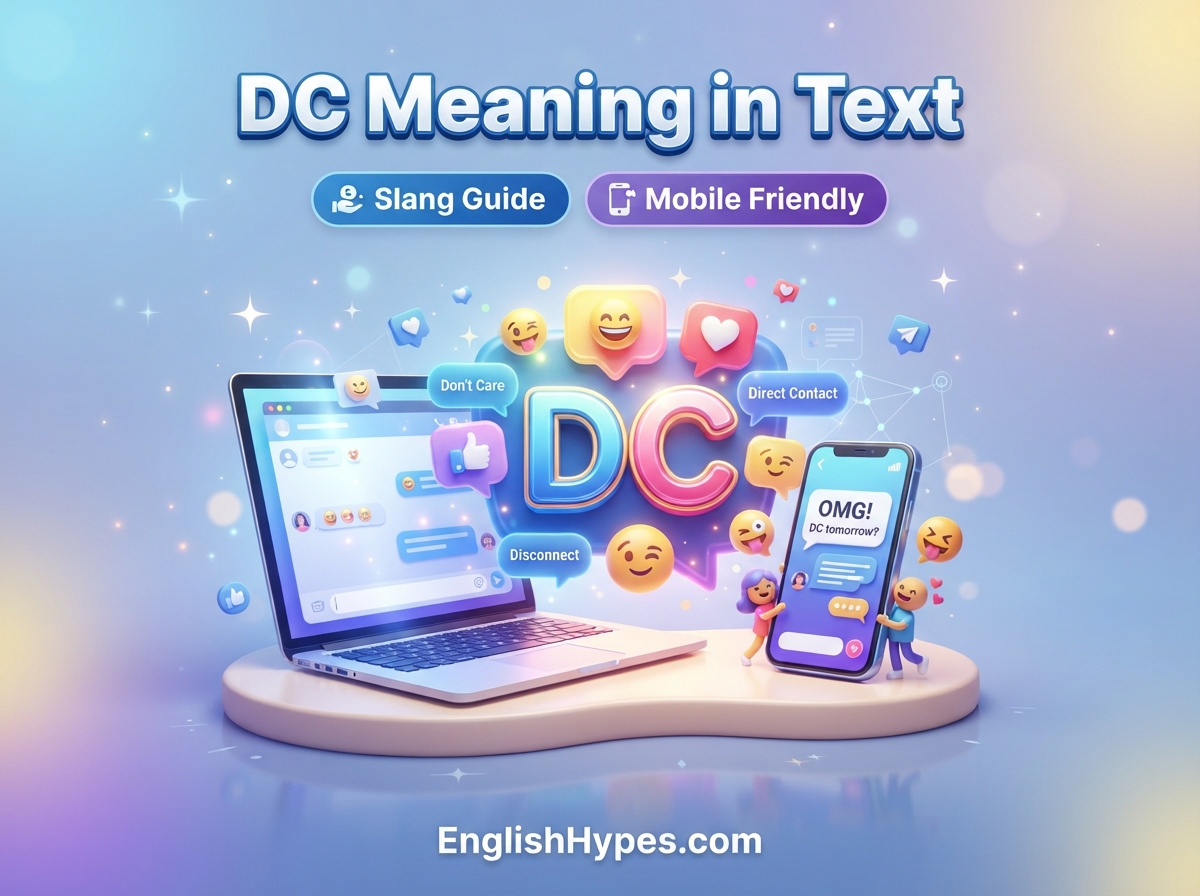
The meaning of “DC” in a text message is context-dependent. Unlike abbreviations that have one widely accepted definition, these two letters can represent different words or phrases depending on the conversation.
In casual texting, one possible interpretation is “don’t care.” For example, someone might write, “DC what they think,” intending to say that they do not care about another person’s opinion. In this use, DC expresses indifference or a lack of concern.
Another interpretation is “disconnect” or “disconnected,” especially in gaming, technology, or conversations about internet connections. Someone might say, “My phone DC again,” meaning their connection was disconnected.
DC can also refer to Washington, D.C., the capital of the United States. If someone says, “I’m flying to DC tomorrow,” they are usually talking about the city rather than using a texting abbreviation.
Outside everyday conversations, DC has technical meanings. In physics and electronics, it commonly means direct current, referring to electrical current that flows in one direction. In other professional settings, it may have industry-specific meanings.
Therefore, there is no single definition that works in every message. The surrounding words, subject of the conversation, platform, and relationship between the people communicating are important clues.
When someone uses DC casually, look at the entire sentence before deciding what they mean. If the message still seems unclear, asking a quick clarification is usually better than assuming.
Background
Internet abbreviations developed alongside text messaging, instant messaging, online forums, gaming communities, and social networking. When people began communicating through devices with limited keyboards or character restrictions, shortening common expressions became a practical way to communicate quickly.
Two-letter abbreviations became particularly popular because they are easy to type and remember. Over time, users began creating their own shorthand for common phrases, emotions, actions, and reactions. Some abbreviations became widely understood, while others remained specific to particular communities.
DC is interesting because it did not develop as one universally recognized texting abbreviation. Instead, the letters already had many meanings before modern texting became popular. “Direct current” has long been used in electrical engineering and physics, while “D.C.” has traditionally referred to Washington, District of Columbia. Technology users may also associate “DC” with a disconnection.
As digital communication expanded, people began using familiar abbreviations in increasingly flexible ways. The intended meaning could change based on the conversation. A gamer, an electrician, a traveler, and someone chatting casually could all use “DC” while referring to completely different things.
This is why learning abbreviations by memorizing one definition can sometimes lead to misunderstandings. Modern online language is highly contextual. People frequently create shortcuts based on the words they use most often with friends or communities.
The best way to interpret DC is therefore to consider context first and abbreviation second. Ask what the conversation is about, what words surround the abbreviation, and whether the person is discussing everyday life, technology, travel, science, or another subject.
Usage in Different Contexts: Chat, Social Media, and Professional Fields
The abbreviation can appear in several communication environments, but its meaning changes according to the setting.
In casual chat
In informal conversations, DC may sometimes mean “don’t care.” For example:
“DC what they say.”
Here, the writer is expressing that another person’s opinion does not matter to them.
It can also refer to a disconnection:
“Sorry, I DC for a minute.”
The exact wording helps determine which meaning is intended.
On social media
Social media users often prefer short expressions because comments and direct messages are fast-paced. DC may appear in captions, comments, replies, or private conversations. However, it is not necessarily a universal social-media abbreviation, so context remains essential.
In gaming
Gamers frequently use DC to mean disconnect or disconnected. A player might say:
“I got DC’d during the match.”
This generally indicates that the player lost their connection or was disconnected from the game.
In professional communication
Professional environments require more caution. DC can have specialized meanings depending on the industry. For example, in electrical engineering it can mean direct current, while in business or logistics it may represent a specialized term or department.
Because abbreviations can create confusion, professional writers should usually spell out an unfamiliar abbreviation when communicating with a broad audience.
The key lesson is simple: DC does not have one universal meaning. The subject of the conversation provides the strongest clue.
DC Meaning in Chat, WhatsApp, Instagram, and TikTok
The meaning of DC can vary slightly depending on how people use each platform.
DC Meaning in chat
In ordinary texting, DC may be used as a shortcut for “don’t care” in some conversations. It can also refer to disconnecting, particularly when discussing internet problems, phones, or games.
For example:
“DC about the drama.”
The intended idea is likely indifference.
DC on WhatsApp
WhatsApp conversations are generally informal, so abbreviations can appear frequently. If someone sends “DC” in a personal conversation, examine the messages immediately before and after it.
If you were discussing someone’s opinion, “DC” may indicate “don’t care.” If you were discussing an internet connection, it could mean “disconnect.”
DC Meaning on Instagram
On Instagram, DC may sometimes appear in comments, direct messages, or community-specific conversations. Because Instagram users often communicate through short comments and slang, the meaning can depend strongly on the people involved.
DC on TikTok
TikTok has many community-specific abbreviations. A term can develop a specialized meaning within a particular trend, fandom, or creator community. Therefore, DC should not automatically be interpreted as “don’t care” simply because it appears in a TikTok comment.
The safest approach is to consider the video, caption, comment thread, and conversation topic.
If the meaning remains unclear, you can simply ask:
“What do you mean by DC?”
There is nothing embarrassing about asking. Abbreviations change quickly online, and even frequent internet users encounter unfamiliar slang.
DC Meaning in Physics, Medical, and Aircraft Terminology
DC has important meanings outside casual internet communication.
DC Meaning in physics
In physics and electrical systems, DC stands for direct current. Direct current is electrical current that flows consistently in one direction. Batteries are a familiar source of DC electricity.
This is very different from casual texting meanings such as “don’t care.” When the conversation involves voltage, circuits, batteries, electronics, or electrical systems, direct current is usually the appropriate interpretation.
DC Meaning in medical contexts
In medical communication, DC Meaning in Text can have multiple meanings depending on the specialty and situation. It may be used as an abbreviation for terms such as discharge or discontinue, although professional medical abbreviations should always be interpreted according to the specific documentation and institutional conventions.
Because medical abbreviations can be ambiguous, they should not be interpreted casually. A person reading a medical note should rely on the surrounding clinical information and, when necessary, clarification from a qualified professional.
DC Meaning in aircraft terminology
In aviation and aircraft systems, DC commonly refers to direct current. Aircraft electrical systems can use DC power for various components and systems, depending on the aircraft’s design.
For example, a technical discussion about aircraft batteries, electrical buses, generators, or power systems may use DC in its electrical sense.
This illustrates an important principle: the same two letters can mean something completely different depending on the subject. In a casual text, DC might express indifference; in engineering, it may describe an electrical current; in aviation, it can be part of technical electrical terminology.
Always use the surrounding subject to identify the intended meaning.
Common Misconceptions
One of the biggest misconceptions is that DC always means “don’t care.” While this interpretation may occur in casual conversations, it is not a universal definition.
Another misconception is that DC automatically means Washington, D.C. The abbreviation is commonly associated with the U.S. capital, but a text about relationships, gaming, or internet problems may have nothing to do with geography.
Some people also assume that every two-letter abbreviation has one fixed meaning. Online language does not work that way. Users often adapt abbreviations according to their community, personal habits, or conversation.
A further misunderstanding can happen when people confuse DC with “IDK,” “IDC,” or “DND.” These abbreviations are different:
- IDC commonly means “I don’t care.”
- IDK commonly means “I don’t know.”
- DND commonly means “do not disturb.”
- DC can have several meanings depending on context.
Notice that “IDC” contains the word “care” abbreviation pattern more directly than DC. Therefore, if someone writes “DC,” it should not automatically be expanded to “I don’t care.”
Tone is another important consideration. Even when DC means “don’t care,” the statement may sound casual, dismissive, humorous, or rude depending on the conversation.
For example:
“DC 😂”
between close friends could be playful.
But:
“DC.”
during a serious argument might sound cold or dismissive.
The meaning of an abbreviation includes more than its dictionary-style expansion. Tone, punctuation, emojis, relationship, and subject all contribute to how the message is understood.
Similar Terms & Alternatives
Several abbreviations can appear similar to DC but have different meanings.
IDC
IDC most commonly means “I don’t care.” It is probably the closest common texting abbreviation when someone wants to express indifference.
Example:
“IDC what they think.”
IDK
IDK means “I don’t know.” It expresses uncertainty rather than indifference.
Example:
“IDK where he went.”
DND
DND commonly means “do not disturb.” It can describe someone’s availability or a device setting.
Example:
“I’m studying, DND.”
AFK
AFK means “away from keyboard.” It is especially common in gaming and online communities.
Example:
“AFK for five minutes.”
Offline or disconnected
In technology-related conversations, DC Meaning in Text may be used informally to describe a disconnection. In clearer communication, however, simply saying “disconnected” may avoid confusion.
The important distinction is that these abbreviations are not interchangeable. If someone writes DC, do not replace it automatically with IDC, IDK, or another familiar abbreviation.
Instead, interpret it based on context.
When writing your own messages, clarity should usually matter more than saving two or three characters. If an abbreviation could easily be misunderstood, spelling out the phrase is the better choice.
How to Respond to It
Your response to DC depends on what the sender means.
If DC means “don’t care,” you might respond casually:
“Fair enough 😂”
or:
“Okay, no worries.”
If DC refers to a disconnect, you could say:
“No problem. Are you back online now?”
If the meaning is unclear, the easiest response is:
“What does DC mean here?”
You can also ask a more natural clarification:
“Do you mean you disconnected?”
or:
“Do you mean ‘don’t care’?”
When chatting with friends, you usually do not need a formal response. A short reaction may be enough.
If the message appears during a disagreement, pay attention to tone. A response such as “DC Meaning in Text” could potentially signal frustration or emotional distance. Instead of immediately becoming defensive, you can ask what the person means.
For example:
“Are you saying you don’t care, or do you mean something else?”
This gives the other person an opportunity to clarify.
If DC appears in a professional or technical conversation, avoid guessing. Ask for the intended meaning if the abbreviation is ambiguous.
The best response is therefore not necessarily another abbreviation. Clarity is more valuable than speed when misunderstanding could cause a problem.
Differences From Similar Words
DC differs from several related abbreviations and expressions.
| Term | Common Meaning | Typical Use |
|---|---|---|
| DC | Context-dependent | Casual chat, technology, technical fields |
| IDC | I don’t care | Texting and social media |
| IDK | I don’t know | Casual conversations |
| DND | Do not disturb | Messaging and device settings |
| AFK | Away from keyboard | Gaming and online chat |
| Offline | Not connected | Technology and communication |
| Disconnected | Connection lost | Internet, gaming, phone calls |
The most important difference between DC and IDC is that IDC has a much clearer association with “I don’t care.” DC can have that interpretation in some informal conversations, but it can also mean disconnect, direct current, Washington, D.C., or another context-specific term.
Similarly, DC and IDK should never be confused. “I don’t know” communicates uncertainty, while “don’t care” communicates a lack of concern.
DC can also be confused with “disconnect.” In technology-related conversations, context can make the meaning obvious:
“The server DC’d.”
Here, disconnecting is likely the intended idea.
But:
“DC what they say.”
suggests an expression of indifference.
The surrounding words are therefore more reliable than the abbreviation alone.
Relevance in Online Conversations & Dating Apps
Short abbreviations are especially common in online conversations because people often communicate quickly through phones. Dating apps are no exception. Users may send brief messages, reactions, or slang because they want conversations to feel casual.
If someone sends DC Meaning in Text on a dating app, you should not immediately assume that they are uninterested. The abbreviation could have several meanings.
For example, if the conversation is about an opinion:
“DC what people think.”
the person may be expressing independence or indifference.
However, if the conversation involves plans, technology, or another subject, DC could mean something else.
Dating conversations require additional attention to tone because text removes many signals that would normally be present in face-to-face communication. A short message can sound playful to one person and dismissive to another.
If you receive an ambiguous abbreviation from a potential date, asking a lighthearted question can prevent confusion:
“Wait 😂 what does DC mean in this context?”
This keeps the conversation relaxed while giving the person a chance to explain.
You should also avoid overanalyzing one abbreviation. Look at the person’s overall communication style. Are they asking questions, responding thoughtfully, and showing interest? Or are they repeatedly giving extremely short replies?
A single “DC” rarely tells you everything about someone’s feelings.
In online dating, context and consistency are much more meaningful than one abbreviation.
FAQs About DC Meaning in Text
What does DC mean in text messages?
DC can have several meanings. In casual conversations, it may sometimes mean “don’t care,” while in technology it can refer to “disconnect” or “disconnected.”
Does DC mean “don’t care”?
It can mean “don’t care” in some informal conversations, but this is not the only possible interpretation. Context determines the intended meaning.
What does DC mean on WhatsApp?
On WhatsApp, DC may be used as casual shorthand, but its exact meaning depends on the conversation. It can refer to “don’t care,” disconnection, or another context-specific phrase.
What does DC mean in physics?
In physics and electronics, DC commonly means direct current, an electrical current that flows in one direction.
How should I respond when someone says DC?
If you understand the context, respond accordingly. If you are unsure, simply ask, “What do you mean by DC?” This is the safest way to avoid misunderstanding.
Conclusion DC Meaning in Text
Understanding DC meaning in text requires more than memorizing a single definition. The abbreviation can represent different ideas depending on the conversation, platform, profession, and surrounding words. In casual messaging, it may sometimes be used to express “don’t care,” while in technology it can relate to being disconnected. In physics and aviation, DC Meaning in Text commonly refers to direct current, while in geographical conversations it can mean Washington, D.C.
The most reliable strategy is to look at the context before interpreting the abbreviation. Consider what you were discussing, what words appear around DC, and the communication style of the person who sent it.
If you still cannot determine the meaning, there is nothing wrong with asking for clarification. A simple question can prevent unnecessary confusion.
As online language continues to evolve, abbreviations will keep changing. Understanding them is useful, but knowing when to ask for clarification is even more valuable.