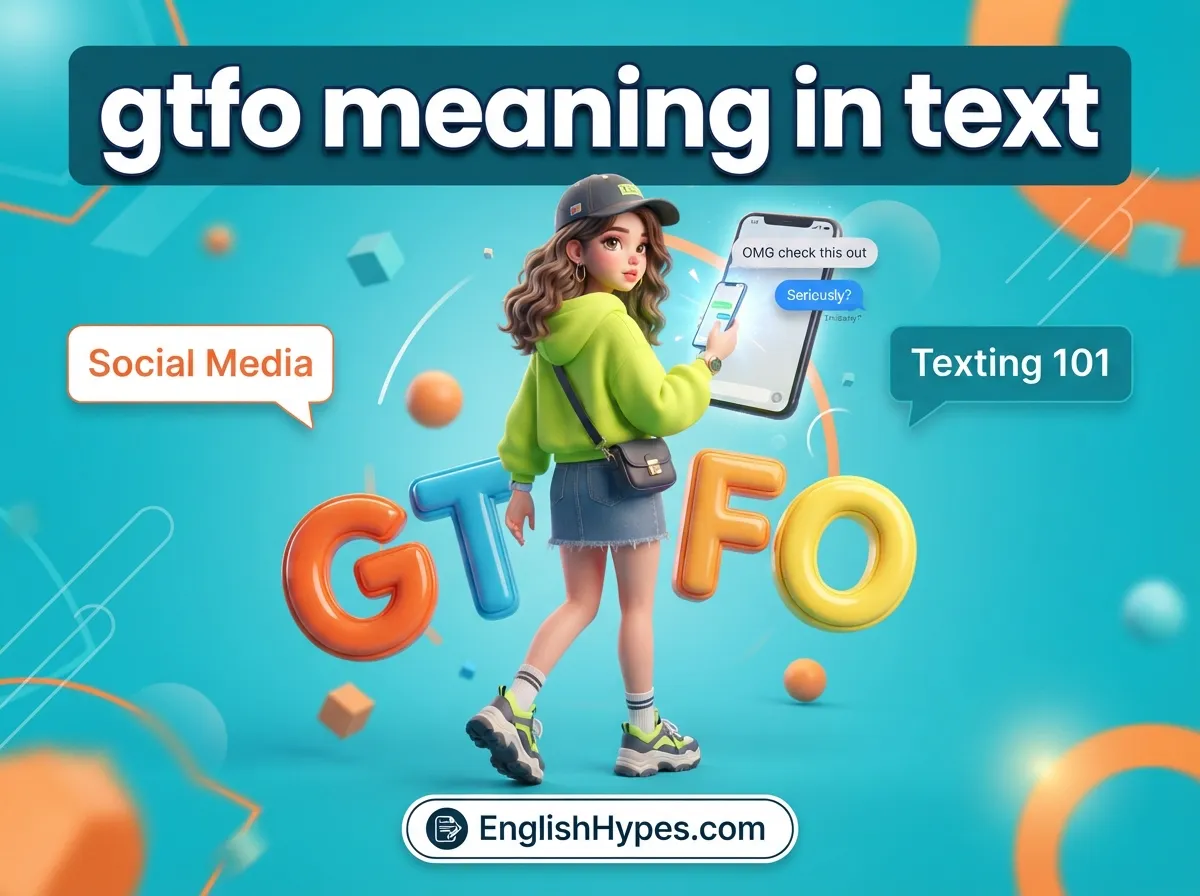
If you have received a message saying “GTFO” and immediately wondered whether the sender was joking, angry, or simply using internet slang, you are not alone. The GTFO meaning in text is commonly searched because this short abbreviation can have very different tones depending on the conversation.
GTFO Meaning in Text is widely used in texting, online chats, gaming communities, social media comments, memes, and casual conversations. In most situations, it is an informal expression that tells someone to leave or go away.
However, friends may also use it jokingly when they are shocked or surprised by something unbelievable. This difference in tone can make the abbreviation confusing for people who are unfamiliar with modern internet slang.
Understanding the context is important before reacting. A playful “GTFO Meaning in Text 😂” can mean “No way, I can’t believe it!” while an angry “GTFO” may be a direct and rude dismissal. This article explains the meaning, background, usage, alternatives, misconceptions, and appropriate responses so you can understand exactly what GTFO means when you encounter it online.
GTFO Meaning and Definition
GTFO Meaning in Text is an internet abbreviation that usually stands for “Get The F* Out.”** It is an informal and often strong expression used to tell someone to leave, go away, or stop bothering the speaker.
The abbreviation contains profanity, which means its tone can range from playful to highly offensive. The exact meaning depends heavily on the situation, the relationship between the people involved, and the way it is written.
For example:
- “You ate the whole pizza by yourself? GTFO!”
Here, the phrase may express surprise or disbelief rather than a genuine demand to leave. - “Stop sending me messages. GTFO.”
In this situation, the expression is much more direct and hostile. - “GTFO 😂 no way that actually happened!”
This is often a humorous reaction meaning something similar to “Get out of here!” or “I don’t believe you!”
Because of its flexibility, GTFO Meaning in Text does not always have exactly the same emotional meaning. The words behind the abbreviation remain the same, but the intention can change.
In casual online language, people often use exaggerated expressions to react to surprising stories. Someone might say GTFO after hearing that a friend met a celebrity, won a large prize, or experienced something unbelievable. In such cases, the speaker is usually not literally asking the person to leave.
However, when used during an argument or conflict, GTFO can sound aggressive and disrespectful. This is why it is important to avoid assuming that every use is friendly or humorous.
In simple terms, the meaning usually falls into one of two categories:
- Literal dismissal: A rude way of telling someone to go away.
- Surprised reaction: A slang expression showing shock, disbelief, or amazement.
Understanding these two meanings makes it much easier to interpret the abbreviation correctly.
Background and Origin of the Expression
GTFO Meaning in Text developed from the longer phrase “Get the f*** out,” an expression that existed in spoken language before internet abbreviations became popular. As texting, chat rooms, online gaming, and social media grew, people began shortening common expressions to communicate faster.
The use of initials made it possible to express a longer phrase with only four letters. Like many internet abbreviations, GTFO became useful because online communication often favors speed, convenience, and informal language.
Early internet culture played a major role in popularizing abbreviations. Chat rooms and online forums encouraged users to communicate quickly, and gaming communities also helped spread short expressions. Instead of typing a complete sentence, users could type a few letters and expect experienced internet users to understand the meaning.
Over time, GTFO Meaning in Text developed beyond its literal interpretation. Online communities began using it as a dramatic reaction to surprising information.
For example:
Person 1: “I accidentally got upgraded to first class.”
Person 2: “GTFO! Seriously?”
In this example, the second person is not demanding that the first person leave. Instead, they are expressing amazement.
This change shows how internet slang often develops additional meanings. Tone, emojis, punctuation, and the relationship between speakers can completely change the interpretation.
For example, these messages may feel very different:
- GTFO.
- GTFO 😂
- GTFO!!! 😭
- OMG GTFO, that’s unbelievable!
The first may sound angry or dismissive, while the others are more likely to express surprise or playful disbelief.
Today, the abbreviation remains part of informal digital communication. However, because it includes a swear word, it is generally unsuitable for formal writing, professional communication, or conversations where strong language may be inappropriate.
Usage in Different Contexts: Chat, Social Media, and Professional Fields
GTFO Meaning in Text can appear in many types of conversations, but its appropriateness changes depending on the setting.
GTFO Meaning Casual Chat
In private conversations between friends, the abbreviation may be used jokingly.
Example:
“GTFO, you actually met him?”
This usually means:
- “No way!”
- “I can’t believe it!”
- “Are you serious?”
Friends may use it as a dramatic reaction without intending to offend anyone.
GTFO Meaning in Online Gaming
Gaming communities frequently use short and emotional expressions. GTFO may be used jokingly, aggressively, or as an instruction during gameplay.
For example:
“GTFO from there before you get eliminated!”
In this case, it can mean “Get out of that area immediately.”
However, players may also use it during arguments, where the expression becomes more insulting.
GTFO Meaning on Social Media
On platforms with short comments and fast conversations, GTFO may react to shocking news, unusual videos, surprising facts, or unbelievable stories.
A comment such as:
“GTFO 😂 That cannot be real!”
usually communicates disbelief.
GTFO Meaning in Professional Fields
The abbreviation should generally be avoided in professional communication. Sending GTFO to a colleague, client, manager, or customer could appear rude, unprofessional, and disrespectful.
Instead, use clearer and more respectful language such as:
- “Please leave the area.”
- “I don’t think this conversation is productive.”
- “Let’s end the discussion here.”
- “Please stop contacting me.”
- “I would prefer not to continue this conversation.”
Professional communication benefits from direct but respectful wording. Internet slang containing profanity can easily create misunderstandings and damage working relationships.
The safest rule is simple: GTFO may be acceptable among close friends who understand each other’s humor, but it should be avoided in formal environments.
GTFO Meaning in Chat, WhatsApp, Instagram, and TikTok
The meaning of GTFO can change slightly depending on where you see it.
GTFO Meaning in Chat
In regular messaging, context is the most important factor. Friends often use the abbreviation as a reaction to surprising news.
Example:
“You’re telling me you won the competition without practicing?”
Reply:
“GTFO 😂”
This likely means “No way!” rather than “Leave.”
GTFO Meaning on WhatsApp
WhatsApp conversations are often personal and informal, so friends may use the expression jokingly. However, a message without emojis or additional explanation can sound harsher.
Compare:
“GTFO 😂😂 You’re lying!”
with:
“GTFO. Don’t message me again.”
The first sounds playful, while the second clearly sounds angry.
GTFO Meaning on Instagram
On Instagram, the abbreviation may appear in comments, direct messages, or reactions to posts.
Someone might comment:
“GTFO 😭 You actually did that?”
This usually expresses amusement or disbelief.
In arguments, however, the abbreviation can become insulting. Reading the surrounding comments can help reveal the intended tone.
GTFO Meaning on TikTok
TikTok users often use exaggerated language when reacting to dramatic, funny, or unbelievable videos. GTFO may appear in comments when viewers are shocked.
For example:
“GTFO, the ending caught me completely off guard 😭”
Here, the phrase is simply an emotional reaction.
Emojis play an important role in modern online communication. Laughing, crying, shocked, or skull emojis can make a potentially harsh abbreviation sound playful.
Still, users should remember that humor does not always translate well through text. If the relationship or tone is unclear, using a softer expression may be safer.
GTFO Meaning in Physics, Medical, and Aircraft Terminology
One common question about abbreviations is whether they have technical meanings in different fields. Unlike some short forms, GTFO is primarily recognized as informal internet slang rather than a standard abbreviation in physics, medicine, or aircraft terminology.
GTFO Meaning In Physics
GTFO is not a commonly recognized standard scientific abbreviation in physics. Scientific communication usually relies on established symbols, units, equations, and terminology. Therefore, if you encounter GTFO in a physics-related discussion, it is more likely being used as casual slang unless the writer has specifically defined it in a unique context.
Technical abbreviations should always be understood according to the document in which they appear.
GTFO Meaning In Medical Contexts
GTFO is not a standard medical abbreviation used for formal diagnosis, prescriptions, or professional medical documentation. Medical abbreviations can be highly specialized, but this particular expression is mainly associated with casual online language.
If you see GTFO in a conversation about health or medicine, it is likely being used as slang rather than as an official medical term.
GTFO Meaning In Aircraft or Aviation Terminology
GTFO is also not generally used as a standard aviation abbreviation for aircraft systems, procedures, or official communication. Aviation communication relies on carefully defined terminology because unclear language can create confusion.
If a person uses GTFO while discussing aviation online, the meaning would usually come from internet slang or an informal joke rather than official aviation language.
This highlights an important point: not every internet abbreviation has a technical meaning. Sometimes people search for slang terms because they assume the letters may represent something specialized.
When dealing with technical documents, manuals, research papers, or professional communication, always rely on the abbreviation as it is defined within that specific context.
Common Misconceptions About GTFO
Because GTFO can be used both jokingly and aggressively, several misunderstandings are common.
Misconception 1: It Always Means “Go Away”
This is not always true. Although the literal phrase is a strong way of telling someone to leave, many people use it as an expression of shock.
For example:
“GTFO, you got backstage passes?”
The speaker probably wants to hear more about the experience rather than asking the person to leave.
Misconception 2: It Is Always Friendly
The opposite misunderstanding can also cause problems. Some users assume that all internet slang is harmless.
If someone writes:
“GTFO. I don’t want to talk to you.”
the message is clearly hostile.
Context matters.
Misconception 3: It Is Appropriate Everywhere
GTFO is not suitable for every environment. Using it with teachers, employers, clients, customers, or people who dislike profanity can create unnecessary conflict.
Misconception 4: Everyone Understands It
Not everyone is familiar with internet abbreviations. Age, culture, language, and online experience can influence whether a person understands the expression.
Misconception 5: Capital Letters Always Indicate Anger
GTFO is often written in uppercase because abbreviations are traditionally capitalized. However, writing:
“GTFO 😂”
does not necessarily mean the person is shouting.
Punctuation, emojis, and surrounding words provide more clues about emotional tone than capitalization alone.
The best approach is to interpret the entire message rather than focusing only on the abbreviation.
Similar Terms and Alternatives
Several expressions can communicate a similar idea, although their tone and level of politeness are different.
For Surprise or Disbelief
If you want to react without profanity, you could use:
- No way!
- Seriously?
- You’re kidding!
- Get out of here!
- I can’t believe it!
- Are you for real?
- OMG!
- That’s Wild!
- What?!
These alternatives work well when you want to show shock or amusement.
For Telling Someone to Leave
If you genuinely want someone to stop bothering you, the wording can be adjusted based on the situation:
- Please leave.
- Go away.
- Leave me alone.
- Please stop messaging me.
- I don’t want to continue this conversation.
- Give me some space.
These alternatives may be clearer and less aggressive.
Other Informal Slang
Some internet users may use expressions such as:
- STFU
- IDC
- WTF
- OMG
- SMH
However, these abbreviations do not all mean the same thing. Some express frustration, surprise, disbelief, or dismissal.
Choosing the right alternative depends on what you actually want to communicate.
If your goal is humor, “No way!” or “You’re kidding!” can work well. If your goal is to establish a boundary, “Please stop contacting me” is more direct and mature than relying on aggressive slang.
How to Respond When Someone Says GTFO
Your response should depend on the tone and context.
If It Is Clearly a Joke
You can respond playfully.
Example:
Friend: “GTFO 😂 You met her?”
You: “I swear, it actually happened!”
Or:
You: “I know! I still can’t believe it either 😂”
Matching the friendly tone can keep the conversation natural.
If They Are Surprised
You can provide more information.
Example:
Person: “GTFO, seriously?”
You: “Yes! I have photos to prove it.”
This helps continue the conversation.
If It Sounds Angry
Avoid immediately escalating the situation. You could respond with:
- “Okay, I’ll give you some space.”
- “I understand.”
- “Sorry, I didn’t mean to upset you.”
- “Let’s talk when things are calmer.”
If someone repeatedly uses aggressive language, you are not required to continue the conversation.
If You Are Confused
It is perfectly acceptable to ask:
“Do you mean that as a joke or are you serious?”
This can prevent misunderstandings.
If You Feel Disrespected
You can set a clear boundary:
“I don’t appreciate being spoken to like that.”
or:
“Let’s continue the conversation respectfully.”
The best response is not always another slang abbreviation. Sometimes a calm and direct message communicates your feelings more effectively.
Differences Between GTFO and Similar Words
GTFO is often grouped with other internet expressions, but each abbreviation has a different purpose.
GTFO vs. STFU
GTFO generally means telling someone to leave or expressing disbelief.
STFU means telling someone to stop talking and is usually more directly hostile.
For example:
- GTFO: “Get out of here!” or “No way!”
- STFU: “Stop talking.”
Both can be joking among close friends, but both can also be offensive.
GTFO vs. WTF
WTF is usually an expression of confusion, shock, or disbelief.
For example:
“WTF happened here?”
The speaker is asking or reacting to something strange.
GTFO, on the other hand, can involve disbelief or a command to leave.
GTFO vs. OMG
OMG is generally much softer. It simply expresses surprise or excitement.
“OMG, you won!”
Compared with GTFO, OMG is usually safer for casual conversations and does not contain profanity.
GTFO vs. “Get Out of Here”
“Get out of here” is the closest non-abbreviated alternative. However, even this phrase can have two meanings.
It can literally mean:
“Please leave this place.”
Or jokingly:
“No way, I don’t believe you!”
GTFO follows a similar pattern but is much stronger because it includes profanity.
Understanding these differences helps you choose language that matches your intended tone.
Relevance in Online Conversations and Dating Apps
Internet slang plays a major role in modern online conversations, including dating apps. Short expressions can make messages feel casual, spontaneous, and humorous.
On a dating app, someone might say:
“You speak three languages? GTFO, that’s impressive 😂”
In this context, the phrase may be playful and show genuine surprise.
However, slang can also create problems. Dating app conversations involve people with different personalities, cultures, and comfort levels. A phrase that sounds funny to one person may sound rude to another.
For this reason, it is important to consider your audience.
If you are getting to know someone, softer alternatives may create a better impression:
- “No way, that’s amazing!”
- “Seriously? That’s impressive.”
- “I can’t believe that!”
- “Okay, now you have to tell me the whole story.”
These responses show personality without the risk of sounding aggressive.
GTFO may work well when both people already share a playful communication style. If the conversation is new or formal, avoiding strong slang is usually safer.
Online communication also lacks important cues such as facial expressions and voice tone. A joke that would sound harmless in person can appear rude in a text message.
Emojis can help communicate humor, but they do not guarantee that the other person will interpret the message correctly.
The key is balance. Internet slang can make conversations entertaining and natural, but respectful communication should always come first.
FAQs
What does GTFO mean in text?
GTFO usually means “Get The F*** Out.” It can express disbelief or tell someone to leave, depending on the context.
Is GTFO rude?
It can be rude because it includes profanity. However, friends sometimes use it jokingly to express surprise.
What does GTFO mean on WhatsApp?
On WhatsApp, it may mean “No way!” in a playful conversation or “Go away” in an angry conversation.
Can I use GTFO in professional communication?
It is best to avoid it in professional settings because it may sound offensive or unprofessional.
How should I reply to GTFO?
If it is playful, respond with humor. If it is angry, remain calm, clarify the situation, or respectfully end the conversation.
Conclusion
Understanding the GTFO meaning in text is mainly about understanding context. The abbreviation stands for “Get The F*** Out,” but its actual meaning can range from a rude dismissal to a humorous expression of complete surprise. A message filled with laughing emojis may simply mean “No way!” while the same abbreviation during an argument can clearly signal anger.
The safest way to interpret GTFO Meaning in Text is to look at the entire conversation, including punctuation, emojis, previous messages, and your relationship with the sender. While internet slang can make online conversations feel more expressive and entertaining, strong abbreviations should be used carefully.
If you are unsure about someone’s meaning, asking for clarification is better than making assumptions. And if you want to express surprise without risking offense, alternatives such as “No way!” or “I can’t believe it!” can communicate the same reaction in a friendlier way.